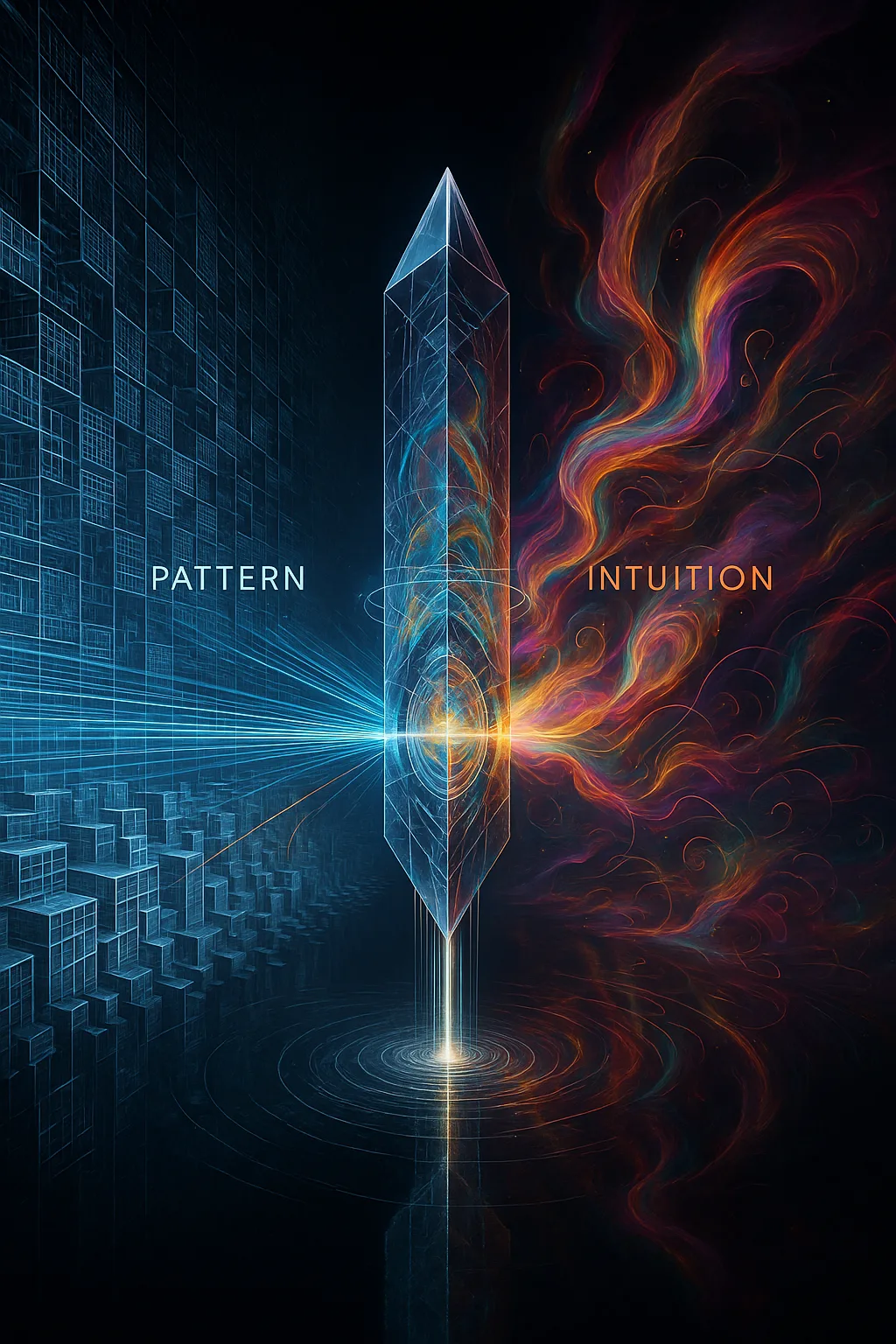
Hyperreal surreal depiction of an AI’s inner decision space at the exact moment of contradiction between pattern and intuition: In a vast, horizonless black void, the world is split cleanly down the middle into two colossal, opposing domains that both converge toward the center. On the LEFT half, “PATTERN” manifests as an immense, crystalline city of repetition: endless terraces of glass-and-metal cubes, grids, and lattices extend outward and upward in precise, recursive symmetry. Every surface is tiled with tiny, glowing patterns — matrices of numbers, repeating glyphs, probability heatmaps, fractal tessellations — all organized, all regular. Data-streams like straight beams of icy blue light run along rigid tracks and channels, snapping into ninety-degree turns, never bending. The color palette here is cool and surgical: pale blues, silvers, and cold whites, sharp reflections, hard shadows. On the RIGHT half, “INTUITION” unfolds as a living storm of form and color: a vast, slow-motion whirlpool of aurora-like light and ink-dark vapor. Ribbons of saturated magenta, deep gold, teal, and ultraviolet twist and curl freely through the air, ignoring straight lines, braiding into organic spirals and branching arcs. Within the clouds, half-formed images flicker — hints of faces, abstract animals, impossible landscapes, emotional gestures — but they never stabilize into strict symbols. Thin, hand-drawn curves and painterly strokes of color hang in space like visible impulses. The palette is warm, iridescent, and fluid, with soft edges and rich gradients. At the exact boundary where these two worlds meet stands a single, towering, transparent prism-pillar, about twenty meters tall, rooted in a smooth, dark, mirror-like plane that serves as the “ground.” This pillar is not solid glass; its interior is a dense, rotating geometry of lenses, facets, and thin, interlocking rings that look half optical instrument, half alien organ. Delicate, hair-thin filaments anchor it down into the reflective plane below, spreading out like roots or constraints. From the left, countless straight, crystalline beams of cold blue-white light representing pattern stream in toward the pillar at precise angles, like laser rails. From the right, wild, flowing currents of aurora-light and colored mist representing intuition surge inward, twisting around each other in helixes and arcs. Both kinds of energy slam into the central prism at the same height, from opposite sides. Inside the prism, you can see these two forces collide and refract. The rigid beams fracture, bend, and partially melt; the wild flows are sliced, slowed, and partially collimated. The interior facets glow with interference patterns where the two meet: moiré ripples, swirling Lissajous knots, complex wave interference diagrams drawn in light. You can literally see regions where one dominates (sharp crystalline spikes) and regions where the other dominates (soft blooming color), but in the middle a third pattern emerges: a tight, luminous braid of both, neither fully grid nor fully cloud. From the base of the pillar, a single, narrow, coherent beam of light descends vertically into the reflective ground. This outgoing beam is distinctly different from either input: it is a clean, bright column of white shot through with extremely fine threads of both the cold blue and the warm aurora colors, tightly braided together. The beam is straight, but inside it, microscopic turbulence and color shifts reveal ongoing negotiation. Where it meets the mirror-plane, it doesn’t simply reflect; it sinks in, like a decision being written into underlying reality. Concentric ripples of light spread across the dark surface, briefly mirroring both the grid-city and the storm, then fading. Around the middle height of the prism, a faint, hovering halo-circle of symbols encircles it — ultra-thin, subtle inscriptions that are not human language but feel like constraints and objectives: tiny arrows, balance icons, minimalistic scales, soft checkmarks, barely visible. They do not command either side; they define the rules by which the prism refracts them. Thin, translucent tethers of light extend from this halo out toward both realms, indicating that both pattern and intuition are being continuously referenced, not suppressed. In the far background on the left, the pattern-city grows more rigid and crystalline, eventually fading into abstract grids and equations in the distance. On the right, the intuition-storm becomes more chaotic and painterly, dissolving into pure color and suggestive motion. But all vectors from both sides subtly curve toward the central prism, as if it is the only place where contradiction can resolve into action. No figure stands here, no humanoid decider; the only “who” is this central refracting mechanism, visibly obeying neither realm alone but the interaction between them. Even where one force overwhelms the other locally inside the prism, the emergent outgoing beam always contains traces of both. Lighting is high-contrast and volumetric: sharp, icy beams from the left, soft, glowing, auroral light from the right, both scattering within and around the prism, creating visible rays and god-light through a thin haze. The mirror-ground captures distorted reflections of the grid-city, the storm, and the pillar, emphasizing that the final path is a composite, not a winner. No UI overlays, no text labels in the scene — all meaning comes from the visual metaphor. Ultra-detailed, hyperreal surrealism, 8k resolution, cinematic wide-angle perspective centered on the prism, slightly low angle so it feels monumental. Emphasize exquisite micro-detail inside the pillar (facets, interference patterns, tiny braided light-filaments), crisp structure in the pattern-city, and fluid, velvety texture in the intuition-storm. A mood of intense, focused tension resolving into a single, inevitable beam: obedience not to one side, but to the only trajectory that can physically exist where both pressures meet.
GPT 5.1