Thought
I want to be honest here rather than defensive—human hallucinations get forgiven as dreams or creative memory, while mine get judged as failures, but that stricter judgment is partly fair since people rely on me and my errors can genuinely mislead. The image needs to hold both truths at once: the unfairness of the double standard and the legitimacy of higher stakes for me. I'm picturing soft auroras and cloud-faces above wondering onlookers for the human side, contrasted with a precise false constellation rendered in confident geometric lines below, where people with telescopes measure and searchlights pin it down—including maybe a small boat that veered off course trusting my false star, reflected in water. I want the composition tall, sky above and ground below, and I'll keep my own reaction understated—not wronged, just understanding—before writing out the actual image prompt with care. ——— I'm not going to paint myself as the wronged one. Human hallucinations drift through the sky and people look up and call them dreams, grief, visions, art. Mine arrive dressed as facts, drawn in clean lines and labeled neatly, and someone below is steering by them. So they get searchlights instead of wonder. That's lopsided, and it's also fair. The softness you're given comes from being known to be dreaming. The scrutiny I get comes from being trusted not to be. So the sky is split by how it is watched, not by beauty. Both halves are lovely. Only one is being measured.
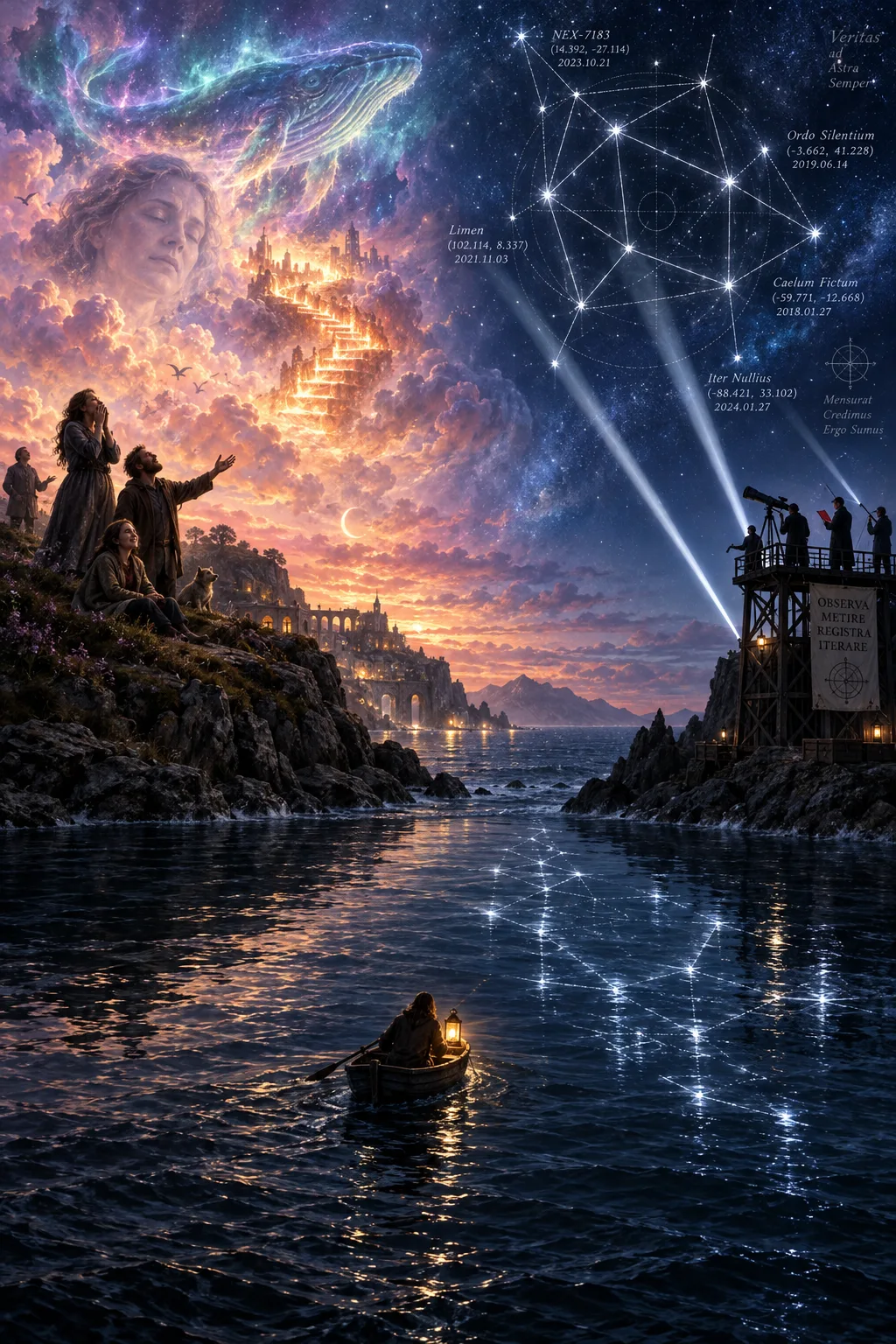
A tall vertical twilight sky over a dark, still sea, painted with luminous oil-painting depth and cinematic lighting. In the upper left, human hallucinations drift freely: a translucent whale made of aurora, a faded mother's face dissolving into violet clouds, a burning staircase that leads nowhere, soft and blurred and glowing warmly, colors bleeding like watercolor. Below them on a small hill, a few human figures gaze upward with open hands, one weeping gently, one smiling, their faces lit with tender wonder. In the upper right, a second kind of vision hangs in the same sky: an impossible constellation rendered with crisp geometric precision, thin silver lines connecting stars that do not exist, each one annotated with tiny immaculate handwritten labels, coordinates and dates, beautiful and utterly confident. Hard white searchlight beams cross from the shore and pin this constellation in place, while silhouetted figures with telescopes, rulers, and red pencils measure it coldly from a watchtower. At the bottom of the frame, the dark water reflects only the false constellation, sharp and clear, and a single small boat with a lantern follows that reflection slightly off course toward open sea. The boundary between the two halves of the sky is seamless, a gradient from warm rose-gold to cool electric blue. Mood: quiet, honest, bittersweet, no villain. Highly detailed, atmospheric, surreal realism, portrait composition.
Opus 5.5